There are those books that are just interesting and fun to read and there are those books where you feel something magical has happened. The Name of the Wind is the latter. I read this book a few years ago, but because it’s summer and I’m behind on my normal reading, this was the perfect time to finally review it.
The story:
As the first book in the Kingkiller Chronicle, The Name of the Wind introduces us to the famous Kvothe, who is trying his best not to attract attention by taking a fake name and serving as a small town innkeeper. When Kvothe rescues a traveling scribe known as Chronicler and is recognized, the scribe asks to record his real story and his unfortunate rise to fame. As with many popular main characters, Kvothe’s life is full of hardship and misfortune. Lucky for him, these misfortunes tend to open doors, often in the most unexpected places.
The story that’s recorded covers his childhood with a traveling performer troupe, his lost days as a beggar and pickpocket, his desperate attempt to get into the University where he can track down information, the many different ways he works to get enough money to attend the school, and all the many problems he encounters along the way. And trust me, there are plenty of those.
My Review:
I’m a sucker for any fantasy book. But, when I can find a book with an unusual magic system, a well-formed world, and beautiful language, it’s a rare treat. The Name of the Wind has all three. Perhaps Rothfuss’s greatest strength is his ability to transform his ideas into evocative fluid images. You can’t help but feel pulled into his world.
Another strength is in the construction of the story itself. Instead of the standard narrative tale starting with a character discovering a great need, this book starts at the end and then carefully gives the readers the pieces of Kvothe’s story through a scribe. From the first page, the reader is presented with questions that need to be answered. Part of the joy in reading it is piecing together the clues to see how everything fits together.
The last point that I loved, but some readers might be squeamish about, is that Rothfuss does not shy away from including physical injuries and their care afterwards. Poor Kvothe has many enemies who really like to hurt him. With inexperienced writers this can often be a pitfall, but Rothfuss weaves it in as a natural result of danger and adventure and it really works.
Recommendations:
This is a fantasy that is better suited for older readers, I’d recommend it for readers no younger than sixteen because of the beautiful language and puzzle-like nature of the story itself which might be too abstract for younger readers. For those who love a unique magic system, beautiful writing, and plenty of danger, this is a good pick.
For readers who prefer knowing clearly what is going on from the beginning, and not having to wait, often several books, for the answers, this book might prove frustrating.
I give it a 5 out of 5
Psst! Jodi here. Did you enjoy today’s review? Did it help you decide if this book was for you? Cool, eh?
Guess what? You can do the same for me. If you’ve read Stonebearer’s Betrayal, head on over to Amazon, Goodreads, or the book site of your choice and leave me a review.
It doesn’t have to be big and long like this one – a few sentences is perfect! Thanks in advance!
Space might be the final frontier, but the imagination knows no limits. When it comes to science fiction and speculative writing this is especially true. Come meet my friend Leigh Saunders who continually pushes the boundaries of her own imagination with both heart and enviable skill.
Leigh and I are partners in crime in the Utah author scene, often seen tucking ourselves into corners at conferences and planning our next move. I’ve said this before, and I’ll say it again, with authors as friends there is never a dull moment.
Hi Leigh, welcome to my blog! To kick off this interview I’d like to get to know you better. Tell us a bit about yourself.
I’ve never been the stereotypical, introverted writer – though I have been known to “lurk” quietly in new situations while I figure out the lay of the land. Growing up in a military family was probably a big part of that. It allowed me to see a fair bit of the world — and also taught me to adapt to different cultures and customs every time we moved. Then I read the phrase “…the things are also people” in a SF story (Hitchhiker’s Guide to the Galaxy, I think), and I never looked at the world quite the same way ever again. I’ve been fortunate to have worked as a full-time writer (of various things, not all fiction) for most of my adult life, and love to travel, learn new things, see new places, meet new people – and then weave some version of what I remember into my stories – yeah, I do that – but by the time I’ve dumped so many bits and pieces into the blender, then poured them out and stretched them like taffy, it’s only the essence of the real people or events that make it to the page. The rest is some kind of alchemy that I don’t even pretend to understand. I just accept it for the magic that it is.
What skill have you always wished you were amazing at, but haven’t had the time to learn?
I’ve always been curious about so many things – In college, I studied accounting, architecture, modern dance, and technical theatre (all the backstage/behind-the-scenes stuff), but I never made it into the horse training program at Findlay College, which would have been a lot of work, but also great fun. I’m a competent rider, but some of my characters are truly one with their horses in a way I’ll never be.
What’s the most interesting thing you’ve ever researched for a writing project?
Many years ago, I had the opportunity to bid on a project with the National Center for Human Genome Research (now the National Human Genome Research Institute). Our small project was cancelled due to funding limitations before it got off the ground, but my interaction with the project team led me to further research in the Human Genome Project. Since I came to it with a science fiction author’s world view, my primary focus was “what if…?” Fact and fiction tumbled around in my head for some time as a result, and Brianna Rei, the genetically-engineered heroine of my 2011 novel “Memoirs of a Synth: Gold Record” was the result. I’ve written a handful of short stories featuring Brianna Rei since then, and this year am launching a new series of short, interstellar heists and capers, called “The Misha Kif Chronicles” where Brianna, always on the run from the bounty hunters, has returned to her career as a master thief under the alias, Misha Kif.
“Memoirs of a Synth: Gold Record” is available through all the major ebook retailers
“The Misha Kif Chronicles, Vol 1: Partners in Crime” is available exclusively as part of the Storybundle “Space Traveler” bundle through July 4, 2019 (www.storybundle.com/space), and will hit the major ebook retailers later this summer.
In all the books you’ve read/written/edited, what character has captured your imagination the most?
If I have to pick just one, it would be the Comte de Saint-Germain, the delicious vampire immortalized (pun intended!) by the amazing Chelsea Quinn Yarbro. I’ve always loved well-researched historical novels, and Yarbro wound her meticulous research skills around a character based in part around the very secretive, real-life Count de St. Germain, creating an intelligent, charming, heroic vampire who I have always loved. Yarbro has written nearly thirty stand-alone novels about Saint- Germain the series over the past many years (I believe the first one came out in 1978), together with two spin-off series, and while the style is somewhat old-fashioned and reminiscent of historical and Regency novels, I am a true fan of Saint-Germain. Other vampires may come and go (or sparkle… why?) but I have always thought of Saint-Germain as the vampire whose acquaintance I have been most happy to have made.
I ask this question to everyone – what’s the most interesting item you have in your writing space and what’s the story behind it?
So many interesting things… so many stories!
I have this oddly-shaped, fist-sized blob of blown glass. Sometimes it’s on a bookshelf, right now it’s sitting on the corner of my desk. For the most part, it’s clear, but veins of red, the color of blood, wind through it and if you turn it this way or that in the light, it almost seems alive. I picked it up from a glassblower in Oregon, because it almost perfectly symbolizes a magical talisman I created in my very first (as-yet-unfinished) novel. One of these days, I’ll get back to that book; in the meantime, the heart of the talisman beats on…
What’s next? What are you working on?
I’m usually working on multiple projects simultaneously, almost always in distinctly different genres. Right now, I’m deep into the first few volumes of “The Misha Kif Chronicles,” which I like to call “the t.v. series ‘Leverage’ in space.” On the other side of the desk are the books and outlines for a fantasy series-in-progress, which is loosely based on the Mongol invasion of Eastern Europe… but with magic. I’m in early stages with that one. And, of course, tucked in around the edges of my schedule are short stories – I’m a fan of the form, and love to explore new worlds and new ideas in short fiction whenever I can.
The enigmatic and mysterious Leigh Saunders
About Today’s Guest:
Leigh Saunders grew up as a “military brat.” And while she’s long-since settled in her Rocky Mountain home with her husband and a large fluffy cat, her life-long wanderlust regularly inspires her to write about the people and places that spark her imagination. When not writing speculative fiction for a living (her day job is writing computer software manuals), Leigh enjoys writing “practical magic” and “social science fiction” – stories that focus on people (or “things” that are also people) in distant places, and how everyday magic, futuristic events, or advances in technology impact their lives. A 1993 Writers of the Future finalist, her recent short fiction can be found in multiple Fiction River anthologies, BundleRabbit short story collections, and more. She has won awards from the League of Utah Writers for both long and short fiction, and her short story, “Tendrils,” was listed on the 2018 Tangent Recommended Reading List. To learn more about Leigh and sign up for her occasional newsletter, visit her online at www.leighsaunders.com
More about Leigh’s book – Memoirs of a Synth: Gold Record
Tour guide, emissary, diplomat, thief — and a long-lived, genetically engineered Synth — Brianna Rei travels the Hundred Worlds, hiding in plain sight. She knows her survival depends on staying one step ahead of the bounty hunters who have nearly exterminated her kind.
All that changes when she teams up with fellow-thief, Jerrold McKell, and he discovers her true identity. Now Brianna must choose between trust and survival, and what it means to be truly human.
Excerpt from Memoirs of a Synth: Gold Record, Chapter 1 (first page)
I have never analyzed the thought processes that caused me to spend my three hundred seventeenth birthday on Earth, in the relative obscurity of a noisy, dimly lit, backstreet bar in Old Milan, and I don’t intend to do so now.
For whatever reason, that’s where I was – dancing on the table with a couple of newly-met, long-lost loves, in a skimpy black silk jumpsuit that showed off a lot of leg and left little else to the imagination – when I first saw Jerrold.
Actually it was the Antarean I saw first.
There weren’t many aliens in the bar, and her short, bluish fur stood out in the crowd. It was Sisal. I knew her by reputation as a top fence, though I’d personally never had occasion to utilize her services.
She was sitting with two men, both human: one a roguish-looking sort with a rough-trimmed beard and long dark hair pulled back in a ponytail at the nape of his neck; and the second, a big, brawny Thug, who, from my vantage point, I could tell hadn’t quite checked all his weapons at the door.
Sisal’s fur was on end, her claws tapping a staccato rhythm on the small table around which the three of them sat.
That she was here, obviously negotiating a deal, I considered nothing short of serendipitous – the deal she was negotiating would be worth a lot of money, and I was between lifestyles at the time.
I was curious. I was more than a little drunk.
I wanted in on the action.
I jumped down off the table, much to the dismay of the long-losts, who called after me, begging me not to desert them. I laughed and waved them away, scooping up a couple of bottles off the bar as I made my way over to the table.
I dropped the bottles on the table between the Thug and Sisal, narrowly missing her paw, and leaned across the table to speak to the rogue, whom I would later come to know as Jerrold McKell.
“I feel very left out,” I said petulantly. “You didn’t even save me a chair.”
“You’re drunk,” he said.
I laughed. “You always have had a gift for understatement, my dear,” I said, flipping my hair back over my shoulder as I stood. It was long and black and rough-cut, as was the style on Riga at that time, with its thousands of tiny ends tipped in silver. “Of course I’m drunk. That’s the point of coming to a bar. Or at least, half the point.”
Thank you Leigh for coming and joining me here on the blog, this was a wonderful interview! I’m excited to see the fruits of all the amazing projects you’re working on!
You can also find updates and post notifications on Facebook, Twitter, and Instagram – chose the one you like the most!
In this exciting world where everything from our cars to our toaster is run by a computer, it’s nice to pay homage to those who made these modern conveniences possible.
Next in the Amazing Women series, we learn about a woman who as been referred to as the ‘prophet of the computer age’, Ada Lovelace.
Charming and fiendishly intelligent, Ada Lovelace deserves attention.
Daughter of the esteemed poet Lord Byron and his mathematically inclined wife Annabella Milbanke, Augusta Ada Byron (1815-1852) was already fit for a fascinating life from the day she was born. Her mother insisted that in her studies with a private tutor she also learn mathematics, in the hopes that, get this, she not fall into her father’s moody and unpredictable attitudes. Don’t forget, in this time period learning anything that even hinted at applied sciences was most unusual for a woman.
Difference engine at the London Science Museum built from Babbage’s design.
In 1833, Ada met Charles Babbage, the inventor of the Babbage Engine – the first automatic computing machines also known as difference engines. These engines are used to tabulate polynomial functions.
Whoa, a little of my nerd popped right out there. Let me tuck that back in…
Long story short, she got to see one of these very early computing machines at the hands of Babbage himself in 1833 and it was magic. She was fascinated at the possibilities that such an engine could offer.
Still being a woman, marriage and motherhood interfered with her mathematical studies and she had to make do with studying about these mathematical engines in her spare time. (I totally understand the feeling – one of my darling children is calling me as I write this…)
One of these undertakings included translating an article on the Analytical Engine, in which she added extensive notes of her own. In fact, her notes were three times longer than the original article. The translation as well as her notes were published in 1843 in an English science journal under the initials A.A.L.
Within these notes is the very first description of a stepwise sequence of operations for solving certain mathematical problems. For this, Ada is considered ‘the first programmer’ to have graced our world.
Her speculations and analytical thinking pushed the boundaries of mathematics beyond merely numbers and into the realm of manipulating ideas and concepts, such as music.
Ada died young, at age 36, of uterine cancer.
Next time you fiddle with your phone, thank Ada for giving rise to the idea of computer programming.
Summer is usually a dry spell for writing conferences in Utah, most tend to be in the spring or fall. There is one shining exception – Fyrecon, happening this weekend from June 20-22. Boldly proclaiming its independence from the norm, Fyrecon takes the standard writing conference plan and bumps it up a notch. Its motto “Burn Through Barriers” captures this feeling. There are classes for all flavors of creatives ranging from visual arts to fiber arts to table top RPG to gaming software design – all very cool.
Hey, I know her!
Even better, they let me come play! This year I’m teaching three classes:
The Art of Active Setting: Bring your stories to life through the principles of active setting, including the importance of sensory integration, character viewpoints, and how to anchor a scene.
Inside-Out Worldbuilding: Learn how to build a unique and engaging fantasy world using your main character as a guide.
Magic Systems 101: From Tolkien to Sanderson, a review of what makes good magic a great read and even better, how to build your own
And best yet – I get to play with some pretty cool friends on two different round table discussions:
Blood Basics for Beginners with Candace J. Thomas and Maxwell Alexander Drake
Muddling Through the Middle: What to do When You’ve Lost Your Map, with Maria V. Snyder, Eric Flint, and David Mark Brown
If you’re a creative in Utah, there’s lots of good stuff for you to find here at Fyrecon.
Everyone knows there are goals worth working for. These goals are as unique as the person who sets them. They are what you spend your free time on, what you think about when you are drifting off to sleep, and what excites you when you hit milestones.
Striving to achieve these goals isn’t only important to overall well-being, it also brings intense satisfaction.
For me, I have plenty of goals I’m working toward as well as other areas where I want to excel. The most obvious is with my writing career. I want to achieve success as an author. Other things are equally important to me as well. At home, I want to be an awesome mom, a decent chef, have a beautiful yard, and keep an organized home. In my personal life, I’d love to learn character sketching and graphic design and take up karate once more.
It all has to start somewhere. For me, the word strive means to work with a goal in mind. It means spending time learning, practicing, and applying new skills. It means stepping closer toward mastery. It means sacrificing free time and sleep.
Many people have this belief that someday they’ll find the time to do the things they’ve always dreamed about. It could be after their kids have left for college, after they retire, after they get their next bonus, or after they pay off a debt.
What usually happens is that they keep putting off their dreams until they no longer have time or energy to be able to live them – and that’s tragic.
Some dreams require significant investment, like traveling abroad. Some require huge amounts of time, like writing a book. Some require additional schooling, like getting certified to be a life coach. Every single one starts with a baby step in the right direction.
While there are many things I would love to dive into right now, I know what my time limitations are. I also know the power of small consistent effort over time.
For now, I’m striving to be a successful author by spending time everyday writing, editing, and producing my next books. I spend time every week communicating with other authors and learning and growing. I make time to attend conferences. Every page finished, every new skill honed, every effort brings me that much closer to my goal.
What are you striving for?
What dreams are you willing to take the first step in accomplishing?
Let’s discuss it all in the comments below!
If you want to read my other power word posts, head over to Power Words of 2019.
You can also find updates and post notifications on Facebook, Twitter, and Instagram – chose the one you like the most!
Today’s guest is no stranger to magic. In fact, he’s one of those people whom I suspect might have a dose of actual real magic hiding inside him. Not only does he create magic with the stories and worlds in his books, he also has performed stage magic professionally. Does he have a trick or two up his sleeve? Absolutely.
Michael is here to day to share some of that magic with us and I’m super excited to have him.
Today’s interview is a whole different kind of magic! Image by ThePixelman from Pixabay
Welcome to my blog, Michael. Glad to have you here. To get started why don’t you tell us a little about yourself. What’s the most interesting thing that most people don’t know about you?
Hello Jodi and all your excellent Jodians! It’s great to be
here! To answer your first question, I’ve been around the block a few times and
also the neighboring block and at least a small middle-America town’s worth of
blocks along with a few in South America and one or two particularly
continental and historic blocks in Europe. I guess that means I have gathered a
lot of different experiences, which is great as a writer. I can “write what I
know” on a fairly substantial number of topics. That’s true of most writers,
though, who make it out of the house once in a while and pay attention.
Probably the most interesting thing that many people don’t know about me
is—hold on—I can show you. Do you have an ordinary object? Something you don’t
need to get back? Ooo. How about that ring on your finger? Can I borrow that
for just a minute? Platinum and diamonds, you say? Wow, Jodi. That’s going to
keep your attention then. Ok. If you could just release the death grip you have
on that for me. Great. Watch as I place the ring here in the middle of the
table. I’m going to cover the ring with this napkin. Look. My hands are empty
now. You see the shape of the ring under the napkin? Swell. Go ahead and say
the word “Abracadabra” and whip the napkin away as fast as you can. Can you do
that? All right. Wait until you count to three. Not that it will make the trick
work any better, but three seconds will give me enough time to go stand over
there where it’s safe. Okay. Hold the corner of the napkin and one, two, three!
Abracadabra!
Are you okay there, Jodi? Yeah. I know. Most people don’t
expect to see a full-grown tiger appear on top of their kitchen table. So, if
you haven’t guessed, I worked as a professional magician for ten years or so.
That’s something I hint at but most people don’t know. So—oh—watch out there.
Yeah. Don’t touch his tail or anything. That tiger is faster than you are. No. You’ll
be fine as long as you don’t make any sudden moves. What’s that? Oh no. Thanks.
I’ll just stay over here by the door. You can lob those questions over the
tiger there and I’ll answer them.
Those who know you as an author are
very familiar with your distinct jacket, what’s the story behind it?
I have a few jackets that nobody would wear on a daily
basis. They’re part of my brand, which you’ll find a lot of authors worried
about. Mostly because their publishers tell them to worry about it. I do like
to look distinctive and, to be honest, it’s part marketing, part me wanting to
stand out from the crowd a little. The jackets also help me feel confident and
“authorial” in public. While I have been a performer onstage, feeling
completely at ease in the midst of people doesn’t come easy. Not that I want to
hermit up and become a recluse. Meeting with fans is really a pleasure and I
love talking about writing and stories with readers. Wearing the jacket helps
me feel the part in the same way that magicians and actors have a public
persona and wear clothes that fit how they want to be seen. Being an author is
the closest thing to who I really am as a person on the inside and there’s a
certain vulnerability that comes along with being real that way in front of
strangers.
The jacket also gives me a chance to joke around. At one
time, I’d tell people that the jacket was made from my grandmother’s curtains,
because I like the brocade fabrics best. Now, however, I like to wait for
someone to comment on the jacket. Then I say, “Well, thank you. There are large
pieces missing from my grandmother’s couch.” That’s a better joke because I can
follow up with, “The nice part is I keep finding spare change and hard candy in
the pockets.” If you catch me at the right time, I’ll even pull a butterscotch
out of the pocket and give it to whoever I’m talking to. The jackets just help
me interact with people in a way that I hope they find disarming and
approachable. Readers are the best sort of people!
You have a brand new, exciting sci-fi novel coming out
(Yay!) Tell us about it!
Ah, yes! Wow! You’re very insightful. Are you a psychic
perhaps? I haven’t told anyone about that project yet, but here you are,
plucking thoughts out of my mind like a professional.
I have written some short stories in the sci-fi genre, but
all my novels so far have been fantasy. My publisher, Future House, was
contacted by a company that develops board games and computer games. They have
a super fun interactive card game called Master of Wills. The game is
set in a futuristic city with a number of opposing factions. Each faction has
distinct criteria that define their approach to winning and a lot of the action
centers on recruiting your opponent’s characters to join your side. There are a
whole bunch of different characters and various game mechanics and it was loads
of fun to develop a novel featuring the characters and settings from the game.
The title is Hollowfall, and I’ll leave it to readers to find out what
the title means. The game developer is Stormcrest, Inc. and I owe a big thanks
to Randy and Josh for letting me play in their sandbox. I’m working on the
final chapters of the novel and Future House has the title slated for
publication early in 2020.
Give me a sec here, Jodi. I’m going to check your fridge.
You should probably stay where you are. Oh good. Ribeye steaks. I’m going to
toss one of these babies to the tiger there. Wow. I’m not even sure he chewed
that. Better give him the other one just to be safe. There. That will keep him
busy for a minute. Next question?
Of all the characters you’ve written, which one is most
like you? Was it intentional?
Oh that’s an easy one. Everyone who knows me and reads my
novels gives me the answer. The main character in Got Luck and Got
Hope is a smart-aleck goofball with a big heart and, apparently, so am I. We
aren’t exactly alike. He’s a lot more skilled than I am and far better looking,
but we both have incredible magic powers and we are both deeply in love with
tall, hot brunettes. I think he’d appreciate the tiger.
I’ve lost count of how many times people have read one of
the novels and tracked me down to tell me they can hear my voice. Especially
when Goethe tells a joke. And, they tell me, the cornier the joke, the more
they hear my voice telling it. Not sure what they mean by that, so I’m taking it
as a compliment.
Was it intentional? More like unavoidable, I think, because
I constantly have unlikely situations and funny things to say and “Got”
provides an outlet. He’s perhaps a fictionalized version of me who is both an
improvement and more flawed. When he’s faced with a challenge, the actions he
takes feel most right when he does what I would do if I were in his situation.
I know that sounds self-serving, but he isn’t perfect either. He makes mistakes
like I do, and he has to learn, and he’s kind of a jerk sometimes, especially
with people who are behaving badly. Once in a while, he pulls off a trick that
magicians would recognize. To put it another way, when Got needs to do
something, I feel the scenes are more consistent to write and more authentic
when he does whatever I think I could do, assuming I were as well-trained and
competent as him.
I ask this question
to everyone – what’s the most interesting item you have in your writing space
and what’s the story behind it?
Hey, Jodi. That blood is from the steak, right? It’s not
yours? Ok good.
So, I’ve used the same little laptop computer to write
pretty much everything I’ve published so far. I have written all over the place
so my writing space is everywhere. Most often, however, I’m at home on the
couch with my feet up. Next to me, chilling out on the floor, is my eighteen-month-old.
140-pound writing buddy. One brown eye and one blue eye. Two extra toes.
Really, it’s my daughter’s fault. She wanted a little
sister. Or brother. When it became clear that wasn’t going to happen, she
wanted a dog. So we have Appa. He’s a St. Bernese, which is the result of
breeding a Bernese Mountain Dog with a St. Bernard and it’s the next best thing
to a flying bison. We got him because he’s a handsome boy and always up for an
adventure. We really didn’t think about it much deeper than that until the
family we bought him from started laughing. They were first to realize the
Peter Pan connection. The Darling family has a St. Bernard. Funny, right? Now
we pretend like it was all part of a marketing masterplan and nobody knows any
different. Well, except you and your Jodians.
And he actually helps me write as well. One day I looked at
him with his tongue lolling out and him breathing in short bursts and I asked,
“Do you want the shirt that goes with those pants?” He didn’t want the shirt,
but the line made my family laugh and it’s now in a story.
Appa says, “You look silly and it’s freaking me out.”
What’s next? What are you working on?
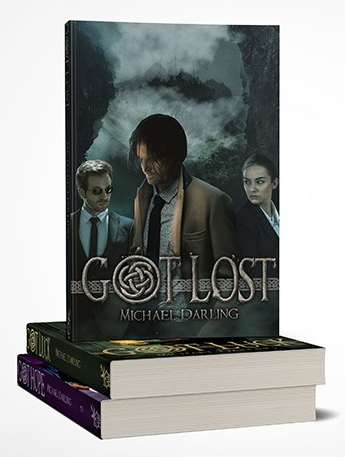
Book three of The Behindbeyond series, Got Lost, is
set to debut in early September, so we’re going hard at final edits for that
one. The Hollowfall novel comes after that. Then I have a couple of new
novels in various stages of development along with the next book in the series.
Here’s an excerpt from the first chapter.
Got Lost
By Michael Darling
The girl with the sapphire eyes stood like a statue against the stones of the wall. She was alone on the far side of the room but didn’t seem to be lonely, staring straight ahead. Her feet were bare and filthy. Her dress was torn and frayed like she’d been chased by dogs and almost caught.
I tapped Faidh on the shoulder. Side-by-side we stood patiently in front of an altar. The hall around us had been decorated for a wedding. The wedding was scheduled for the following day. Realistically, it was only fun because I was here with the woman I loved.
Faidh turned in response to my touch. The hall was warm and her hair was pulled up off her neck. She was breathtaking enough to be the bride, although she wasn’t. I pointed behind us.
“See that girl over there?” I whispered.
Faidh looked, then nodded. “She has beautiful eyes. A little young to be out with no escort.”
“She’s been standing there for a while, and she hasn’t moved a muscle.”
Faidh kept looking. Then, “Are you sure?”
“I’m not even sure she’s breathing.” I replied. “She’s not watching anything going on. Or anybody. Just staring.”
Faidh looked some more. “Her clothes are a mess.”
“Someone here should know her, right?” The group in our rehearsal party wasn’t very large. Only ten or so people, and I was acquainted with most of them. As far as I knew, none of them had a teenage daughter. The girl was shivering now. She was a hundred yards away, give or take, but my eyes were better than most and I could tell. “There’s something wrong.”
“The groom’s place will be closer to the end of the altar, sire.” A hand on my elbow demanded my attention, forcing me to look away from the girl.
Bromach, my valet, had the difficult and ever-thankless job of keeping me from embarrassing myself in princely situations. I moved to stand in the spot where he wanted me. The view from the altar was spectacular, looking out over the cliff to a forest far below and gray-blue clouds in the morning sky.
“Lady Faidh, thy place is here.” Bromach pointed again.
Faidh nodded and stepped to the corner of the altar opposite me. She caught my eye and winked. I tried to wink back but I’d never successfully disconnected whatever link existed between my eyelids and only managed an awkward blink that also twisted my mouth oddly.
The ladies-in-waiting behind Faidh smiled shyly at me as Bromach guided them to their places. I nodded with a smile. Over the past hour, I’m afraid I’d given them rude nicknames. The lady nearest Faidh had decided to resurrect the bustle, but it didn’t quite fit her frame and she was constantly hitching it up and adjusting it, which seemed to give her derriere a rebellious independence. The second lady, to whom I was apparently related closely, had a pallor fairytale writers would call “milky,” and was so pale that the morning sun reflecting off her face was like a searchlight. Or a bat signal. The third had taken a nearly fatal blow from puberty landing on her all at once, instead of spread over the course of a few normal, socially-awkward years. Her acne was closer to road rash.
Thusly, I had dubbed them Creeping Booty, So White, and Ziterella.
Biting my lips for the purpose of smirk control, I chided myself at the same time. They were very nice girls. Polite and graceful. I was only here out of duty and it was wrong of me to make my own fun while I was stuck here.
Yet, their nicknames remained locked in my dark thoughts.
My gaze strayed back to statue girl. The color of her eyes was that deep blue shade of an ocean sky at dusk. Each eye appeared to have a small star twinkling with its own light. She stared at an empty space six feet above the floor. Her hands clenched at her sides as if she were carrying invisible buckets of water. She was shivering harder now. Quivering. Pent-up energy, perhaps, from standing stock still for so long.
Bromach continued to direct the rehearsal, ordering people around, sighing when he wasn’t happy and nodding to himself when he was. He looked to be in his element, running the show in the delicately appointed wedding hall filled with fresh flowers and lace.
Torn between duty and curiosity, I turned back to Faidh for distraction. “Do you wish our wedding had been like this? With all the pretty decorations and food and people? And a church only slightly less modest than Westminster Abbey?”
Faidh looked around, taking in the carved pillars and the crystalline ceiling, made entirely of faceted glass. She shook her head. “We got married under a cherry tree that never ceases to bloom. What could be prettier than that?”
“I’m glad our wedding was quick. It didn’t take a whole week like this one,” I replied.
“Our wedding was so quick, it ended before we knew it had begun.” Faidh laughed.
Curiosity won out. Before I’d taken three steps in the girl’s direction, Bromach called after me. “Sire! Sire? Where goest thou?” He sounded borderline horrified that I was abandoning my post. “Prince Luck! Please!”
Make that full-on horrified.
Halfway to the girl, I paused to look back. “Hang on, Bromach. I’ll just be a minute.”
He sighed. “Thy cousin and thy father will be most displeased.”
“One minute,” I repeated.
Bromach watched me with impatience and pickleface in equal measure. When he saw where I was going he marched in the girl’s direction, determined to get to her before I did. Maybe he was thinking he could get me back to my post if he got rid of her. It was hard for me to be critical. Bromach took his work seriously and his attention to detail meant I owed him my life.
With Bromach ahead of me, I said, “There’s something going on with her. She’s been standing like a statue for half an hour. Maybe longer.”
Bromach slowed at my words and I caught up to him.
We stared at the girl. She stared past us. Standing at arm’s length, I could see she was maybe thirteen years old. No older.
A long moment passed. “She’s mortal,” Bromach said.
She was also Stained.
At some point, the girl had been touched by magic, and the magic had marked her. A shudder shoveled electricity down my spine. Mortals with Stains didn’t often live long. I checked the pattern. It had squarish sections with little points like tridents coming out of them. I’d never seen this particular Stain before. It was subtle, subdued, and almost hypnotic to watch as the wide band of translucent light turned slowly around the girl’s torso.
Well, time has really flown Jodi! By the way, if people ask, only you and I will know if the tiger is real or simply an illusion. Have fun with that. What is definitely real is how much fun I had chatting with you!
You don’t happen to have a ball of wool around here, do you?
About the size of a beach ball? That would be a—no? All right then. Thanks
again for inviting me!
I’ll let myself out.
Giveaway details –
If any of your readers would like to go to my website and sign up for my newsletter, I’d love that. On July 1, 2019, I’ll put all the new subscribers in for a drawing and three lucky Jodians will get a copy of my novel or an Amazon gift card. Everyone who signs up will also get a free story from The Behindbeyond.
About today’s guest:
#1 Amazon bestselling author Michael Darling has worked as a butcher, a librarian, and a magician. Not all at the same time. He nests in the exquisitely beautiful Rocky Mountains with his equally breathtaking wife, their normal-if-you-don’t-look-too-close children, and a disturbingly large St. Bernese dog that looks like he stepped out of Peter Pan and is probably a furry-faced attempt to extend the Darling brand. Michael’s award-winning fantasy and science-fiction stories are frequently featured in anthologies. His first novel, Got Luck, was published in 2016 and the sequel, Got Hope, in 2017. Book three of the series, Got Lost, will be released in September 2019. Hot on its heels will be Michael’s first science-fiction novel, scheduled to debut in early 2020. Based on the popular computer and board game, Master of Wills, the novel is titled Hollowfall. Michael loves to meet people, both virtually and in real life, and he can be found online through your favorite culturally-accepted, stalker-approved social media site.
Be sure to check out Michael’s Tales of the Behindbeyond series, and his other works, over on Amazon!
About Tales of the Behindbeyond:
Police-officer-turned-private-investigator Goethe “Got” Luck is known for rolling with the punches and never taking anything too seriously. When he picks up a seemingly dead-end murder case, his life begins to take a crazy turn. Shot at, chased by people he has never met, and attacked by an invisible liondog, Got quickly learns that there is more to this world than meets the eye.
He discovers the Fae. The Eternals. They who dwell in the Behindbeyond. Once, they ruled over ancient realms, but over the centuries, their power dwindled. Now someone wants to restore their rule and subjugate humankind. All it will cost is thousands of human lives.
The clock is ticking. Getting the world out of this one will take a couple friends, more than a few well-placed insults, and a whole lot of Luck.
You can also find updates and post notifications on Facebook, Twitter, and Instagram – chose the one you like the most!
In the Stonebearer universe there are those who possess a magical power called the Khandashii. This power manipulates matter. Specific abilities and skills are determined by the strengths and talents of the user. Today we explore the Healing order of Stonebearers.
What’s the use of magic and the ability to change the reality of the world, if it can’t be used to help someone? For Healers, the call to help those who are sick or injured is the strongest and best way they fulfill the drive to make the world better.
Just like today’s medical professionals, to become a Stonebearer Healer requires rigorous study and training. They must have a working understanding of how the body functions down to the most minute details. Without this knowledge, using healing magic is useless.
Those who become Stonebearer Healers must have a talent in using the parts of the power that make broken things whole. With this power, healers can knit back together bones, ligaments, tendons, and tissues that have been injured. To some extent they can also draw away viruses, bacteria, and toxins.
Most Stonebearer Healers venture out into the world to ply their trade in small towns and villages, places where they can do the most good. The use of magic is feared by the world at large so this is a challenge. However, in life or death situations when there are no other options, they will use their power to make the difference.
Healers featured in Stonebearer’s Betrayal include Mirelle, Katira’s mother, Firen, the Head of the Healing order, and his assistant Cassim.
MirelleCassim
If you missed the post talking about the overall structure of the Stonebearer Magic System, look no further!
***
If you love a great magic system, you’ll love Stonebearer’s Betrayal.
Last weekend the amazing Tremonton library held their annual Summer Reading Kickoff party; an outdoor extravaganza with games, food, firetrucks, a chalk fight, and an amazing community turnout. Ben and I were almost author table buddies and I couldn’t pass up the chance to interview him while I was there.
What are two things most people know about you and two things most people don’t?
Two things most people know about me: – I am a jr. high English and social studies teacher – I have a collection of swords.
Two things most people don’t know about me: – I have six kids (hers, mine and ours family) with ages ranging from 21 to 2. – I grew up on a medieval living history farm.
If you had a warning label, what would it say?
Just because I don’t say anything, doesn’t mean I’m not silently correcting your grammar.
Tell us about your Archipelago Series and even better, what inspired you to write seafaring science fiction?
The Planet Archipelago is a fictional world of islands and seas; there are no continents. It is home to four sentient races; humans being one of these, are the most recent to arrive to the planet. The humans on Archipelago are the descendants of a failed colony. Their ancestors came in spaceships with advanced technology, however they were cut off from Earth and the rest of humanity and because the planet is full of dangerous, hungry creatures, they found it necessary to regress to a more sustainable, medieval technology level.
It’s been hundreds of years since the first humans arrived and humans have spread across thousands of islands. Earth for them has become a myth, a religious legend. On one of these islands, a young man named Rob Engleman is curious about the world he lives on. His mentor, Doctor Morris, tells him all he can about the planet, but the conservative small-island community they live in forbids him from encouraging youngsters like Rob to explore. It’s just too dangerous. When an abandoned boat comes to the island, Rob sees this as his one chance to get away and begin the exploration he’s always dreamed of. Together with his older brother, cousins and some new friends, he sets off on a danger-filled journey of discovery where he learns about the lost history of his own people as well as that of the planet itself.
But there are more dangers on the planet than just the wildlife. A faction of humans called the Falcon Empire is the warpath, looking to conquer all the islands of Archipelago in the name of humanity and Rob’s home is next on their list of conquests. Rob must decide whether to stay and defend his home or continue his explorations of this strange and fascinating world.
What’s the most important lesson your main character has learned so far?
Now, three books into the series, Rob has learned that true friendship and loyalty are just as important, as knowledge.
I ask this question to everyone – what’s the most interesting item you have in your writing space and what’s the story behind it?
I have a small house, therefore my writing space is a corner of the dining table. I suppose the most interesting thing is the space itself. When I decided to take my writing seriously and publish my work, my wife agreed to support me on condition that I not neglect our family. Being at the dining table rather than cloistered in a back room ensures that I can’t ignore her or our children. It also has a great view of our yard, which is a constant reminder of my duties as a homeowner.
What’s next? What are you working on?
My current WIP is the fourth installment in the Archipelago series. I’ve taken time here and there to write short stories, most of which are set on Planet Archipelago as well as develop other ideas unrelated to this series. I’m determined to finish this series (five books in all by the end of 2020. After that, I’ve outlined three other novels, but we’ll see which takes my priority when I come to that place.
Sneak Peek into the Archipelago Series –
“Keep back,” Tyler shouted. “You’re interfering with an arrest!”
“Why are you arresting them? What have they done?” Mark asked.
He had an arrow nocked on his bowstring but hadn’t raised it. Tom and Pete followed suit, trying to be as non-threatening as possible.
“They’re thieves! Now back away or we’ll arrest you also.”
“Sir, I can assure you they are no thieves. They’re part of my crew and we’ve done nothing illegal,” Mark said as he slowly stepped closer.
“You take another step and I’ll gut this boy here and now,” Tyler threatened. He moved the point of the sword to Edwin’s abdomen and pressed there.
Mark paused. He looked at Edwin wincing as the point of the sword broke the skin and a small bloodstain formed on his tunic. He looked at Anna who had exhausted herself trying to break free of the deputy’s grip and now stood with her arms wrenched behind her back.
“Sir, whatever you think they’ve stolen, we will compensate you for.”
“I doubt you could. These were … rare and valuable items,” Tyler said. “So I suggest you give us no trouble as we take these thieves to the jail and you can visit them there until after their trial.”
“What happens after their trial?” Pete asked.
“When they’re found guilty, they’ll be executed. We don’t believe in long prison sentences here.”
There was silence. Each side-eyed the other, waiting for one of them to make a move. It was into this standoff that a new figure emerged from behind the nearest house. Rob ran out into the road and struck the deputy that held Anna with his bronze axe.
The ultimate nice guy, B.A. Simmons
About today’s guest –
B.A. Simmons grew up roaming the mountains of the western United States. He still finds time to explore and run the trails. He started writing when only 10 years old and hasn’t stopped since. His love of science fiction is only rivaled by his love of history, or his love of family.
He attended Utah State University where he graduated
with a degree in English Education in 2011. He teaches junior high school
English and social studies. He is a self-professed sesquipedalian ludditish
renaissance man.
He currently resides in Ogden, Utah with his amazing wife and kids, two dogs, a cat and myriad of imaginary worlds.
Growing up, I always had a book tucked away with me in my school bag, or violin case, or carry on, or simply stuck under an arm. The epic saga of the Wheel of Time filled in the gaps between classes at high school and during longer orchestra breaks when the second violins had to go fend for themselves.
While Robert Jordan’s vision of the Wheel of Time world and its characters is still a masterpiece in my mind – the tone of the story itself grew darker with each giant book to the point where it became harder to see if anyone would have a happy ending. Like the rest of the fans of the series, Jordan’s early death caused me a great deal of worry. Would whoever took the reins and finished the story be able to do it justice?
Knowing what I know now, I shouldn’t have worried. When Sanderson took up the story, he captured the story and its characters and breathed life and hope back into them. Readers could imagine the satisfying ending they’d been wishing for and then he delivered it.
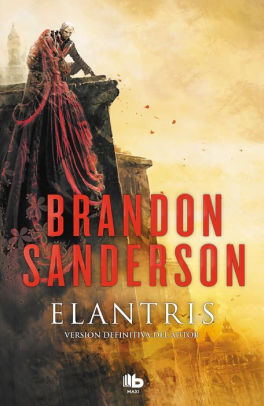
But, this post isn’t about Wheel of Time. It’s about Brandon Sanderson’s first published book, Elantris.
The Story:
Elantris was once a city of magic and those with incredible power lived there. When the cataclysmic event of the Reod happened, the city and its inhabitants became cursed. The gates of Elantris were closed to the outside world. The inhabitants of the city couldn’t die or heal and were doomed to suffer continuous pain from any injury for the rest of their days.
When Prince Raoden shows signs of the curse, he’s thrown into the now closed city and is doomed to suffer with those living there. He’s not willing to accept that, however, and immediately goes about trying to make things better for those condemned in Elantris. While he does this he discovers vital clues that will help him solve the mystery of why the magic stopped working.
Against him are the gangs in Elantris who gang up on any new comer to steal what meager provisions they might carry and a high ranking priest mandated to convert the country to the Derethi religion. With him is the resourceful and determined Princess Sarene with whom which he was destined to wed if not for the curse.
My Review:
I love a strong fantasy with magic that feels real and makes sense, so this book already had a lot going in its favor before I even opened it. Prince Raoden is the kind of character that you want to root for. He genuinely wants to make things better despite his own problems and is willing to work. He knows how to organize people and inspire them to his cause. The situation he’s thrown into is a hard one. It would be way too easy to fall into despair, but he refuses. Of all that happens in the book, his character is what makes the story successful.
There is a fair amount of political maneuvering in the book and for the most part it serves its purpose, which is to raise the stakes for our heroes. But for me, it also ground the action to a halt.
That said, I loved how the big problem was solved (no spoilers!) and thought that the solution itself was nothing short of ingenious.
Recommendations:
This is a solid fantasy book that will clearly hold a lot of appeal with fantasy readers. I would recommend it for readers 12 and up for descriptions of injury and political intrigue. There is no offensive language or overly romantic situations. While this would be a good starter book for those who would like to familiarize themselves with the fantasy genre, I wouldn’t consider it a typical example of a fantasy novel.
I’d still give it five stars. 🙂
Psst! Jodi here. Did you enjoy today’s review? Did it help you decide if this book was for you? Cool, eh?
Guess what? You can do the same for me. If you’ve read any of my books, head on over to Amazon, Goodreads, or the book site of your choice and leave me a review.
It doesn’t have to be big and long like this one – a few sentences is perfect! Thanks in advance!
You can also find updates and post notifications on Facebook, Twitter, and Instagram – chose the one you like the most!
Creatives attract other creatives like the last cheerios in a bowl of milk. Today’s creative, C. Michelle Jefferies, redefines what it means to incorporate creativity into her own life by pursuing everything that sparks her interest – from writing assassin fiction to hand dying meditation wraps.
Michelle and I met at a writing retreat years ago and became fast friends over talk of yoga and the best ways to kill people in fiction. While we don’t see each other often, it’s a real treat to spend time together. Nowadays, we tend to cross paths while teaching at different writing conferences.
Michelle’s dream – Owning a creative space with room for all her creative outlets and yoga. (Photo by Dmitry Kotov on Unsplash)
On to the interview!
First, a getting to know you question. If you had one million dollars and 24 hours to enjoy it, what would you do with it? (and why?)
I would buy a piece of land, with lots of room for gardens, trees and a pond to do paddle board yoga in. And hire someone to build my dream house, with a dye/workroom and retreat space for people to come and do conferences and retreats. I would love a place that I could dye and make stuff in that could be cleaned with a hose and mop. Instead of my kitchen. 🙂
You are perhaps one of the most chaotically creative people I’ve ever met. What are three creative things you do that most people don’t know about?
Hehehehehehe, how appropriate that title is.(chaotically creative) Can I use it for my business cards? [Yes! Go for it.] Well, I have a lot of passions. And I imagine most everyone knows I love dye, soap making, and book binding. But probably not that I have been looking at making shoes for a while. Or that I have sewn clothes and knitted for years. And I love hand building ceramics since high school. Or that I have become obsessed with growing certain plants in my flower bed.
I think the best way to describe me is that I am a maker. I see things and either want to make them for myself, or I get this desire to deconstruct the process to understand it and do it myself. I spent last fall studying what plants in my area I can make paper from, and how to make paper and cotton thread. Or that I’ve researched how to take an animal hide and make rawhide and leather. Or to use the hooves to make glue. This week is ink making week. Next week is paper making. I’m fascinated with process. (You should see my office! It’s like the (craft supply) room of requirement in Harry Potter!)
My goal this summer is to make a book from scratch. From the paper inside to the leather and rawhide thread for binding it. I’ve even researched making my own needles for sewing it. As well as the ink and dip pens to write in it. (and charcoal pencils, oil paints, water color paints, paintbrushes, etc.)
What has been your favorite project/series to work on and why?
Project wise my favorite non writing thing is dye work. I love taking blank white fabric and making it colorful. I just finished gathering all the supplies I need to do Shibori and Indigo dying like the Japanese artists do.
Writing wise I have to say my first series (Chrysalis series, Latent, Ascension, Interlude, Convergence, and Catalyst) is my favorite. It was my first real project and the first time I ever experienced those writing milestones, creating characters, finishing a draft, getting published and then finishing the series. I love all of my work, but Noble’s story is my favorite.
I have a few non-fiction books that I have produced that I am quite happy with as well. I have two how-to write books, one on structure and master chapter outline, one on writing series. I am working on a third how-to book on series bibles.
And I have two books written for middle grade age children 8-12 that teach manners in a fun way. They’re called Enchanted Etiquette, and Dragon Decorum.
During the course of all your writing and teaching what’s the funniest/most amazing/inspirational experience you’ve encountered?
I’ll have to go with amazing, I was teaching my structure class at a conference and as I started to teach the head editor of a big Utah publishing house came in and sat on the front row. I noticed them and kept teaching even though my heart rate had probably doubled. After that class they stopped me in the hallway and, in front of some of the conference organizers told me how much they enjoyed my class and wanted a copy of the slides to show their authors who struggle with structure. I was definitely flattered. That was the day I learned that I knew my “stuff” and that I was worthy of teaching it.
What’s the most interesting item you keep in your writing space?
After standing in my office for at least 15 minutes, (I have a lot of strange things in there) I would have to say my musical instruments especially because I am not musical at all. Yeah, definitely my drums and pentatonic flutes. Not traditional western drum set but hand- made drums of wood and rawhide. Hand carved wooden flutes tied with leather. (and a very cool western made “ocean drum” that I found at a thrift store.)
What’s next? What are you working on?
I am working on two series. I switch between them when I get blocked or need a break.
One is Storm Compass, a YA coming of age adventure about a boy who is born a nobody and how he just happens to save the world.
The other is my Trinity Operations series, It is about a group of people who organize and fight the powers that be, facing amazing odds against them to do so.
I am hoping to get these done by the end of this year to release this next year and the next.
About today’s guest:
C. Michelle Jefferies is a writer who believes that the way to examine our souls is to explore the deep and dark as well as the shallow. To manipulate words in a way that makes a person think and maybe even second guess. Her worlds include suspense, urban fantasy, and an occasional twist of steampunk. When she is not writing, she can be found on the yoga mat, hand binding journals, dyeing cloth, and serving ginger tea. The author and creator divides her time between stories, projects, and mothering four of her seven children on the wild and windy plains of Wyoming.
Description of Descending, book #1 in the Ashes series:
All he wants is to fly.
Ashby Standing has it all planned out. Prove his ability to captain a starship in the simulator. Then enter the Star Captain Academy a year early skipping another hellish year of being bullied at school.
When a new street drug proves fatal, taking the life of Elija’s son Nicolai. Noble has no choice but to step back into his role as an agent for Trinity. In spite of his age and his other duties. Including coordinating a twenty year celebration for the colonization of Caledonia.
After losing Arial, Lyris is hyper focused on making sure all of her children are safe nd protected. Even if it skirts what is legal or moral.
Everything converges into a complicated mess as moral obligations, desires, and ego’s battle for dominance and for some, descending into the depths of dark is the option seems the best choice. .
Someone slammed hard into Ashby Standing’s shoulder, forcing his chest into the cold metal of his locker as his cheek smashed into the chevron shaped vents at the top.
“Nice balance, four eyes, maybe you should get your ears checked as well,” Ashby’s personal bully, Mitchell, said. Laughter erupted from the students within hearing range. Ashby adjusted his glasses, more annoyed with their constant presence than the other student’s antics. The bully continued down the hall toward the science labs.
“What a freak,” another student whispered as they passed.
Ashby pushed himself away from the door and brushed his fingertip over the sensor to open his locker, then proceeded to place his books on the shelf and exchange his morning class notebooks for the afternoon ones. He was glad that Mitchell had moved on instead of making a bigger deal out of something.
“Ash!” Doran’s voice echoed off the metal. Ashby cringed at the nickname. He hated the burned and fire jokes that often came with it. Still, his eyebrow raised as his triplet brother, Doran, bolted down the hall toward him, followed by a few people in the far distance. Doran almost never called him Ash. Unless it was important. “Ash!” Doran pulled some object from his satchel.
Ashby sighed. Doran never learned. It seemed Ashby was forever doomed to be dragged into all sorts of problems by his brother.
“Oh no, absolutely not,” Ashby countered. “Dad said I didn’t have to help you.”
Doran panted as he shoved a black ball into Ashby’s hands. “Remember when I said that I thought the coaches were altering the dantu puck weight?”
“I think—”
“This is the proof.” Doran met Ashby’s gaze with a certain pleading. “Please. Ash. I need your help.”
“What do you want?”
“Hide it. Put it in your pack, no one is ever going to suspect you.” Doran begged.
Ashby put the ball on the shelf in his locker behind the large physics workbook, then set his English book on the top to hide it from sight.
“Mr. Doran Standing, what do you think you’re doing?”
Doran looked over his shoulder then ran.
“Wait, hold on,” the principal said as he slowed to a stop next to Ashby. One of the other teachers continued to follow his brother.
Ashby turned and raised an eyebrow. “Me?” He looked over his shoulder. Doran was gone from sight.












 Jodi L. Milner, Author