Writing Exercise: Three Nouns

800px-Sharpened_Pencil

One of the toughest parts of the writing process is getting started on a new project. While the easiest way to overcome white page paralysis is to embrace the “crappy first draft” idea there are other options. Today’s writing exercise comes from WritingExercises.co.uk where you can find hundreds of prompt generators, randomizers, and all other sorts of golden nuggets.

The exercise:

Take three nouns and freewrite

The beauty of this exercise is that it allows the brain to make abstract connections between three unrelated objects which often generates fresh characters, places, and stories. 

Freewriting is best with a timer and an atmosphere free of distractions. I prefer 15 minute chunks. It’s long enough to form a few concrete ideas and begin running with them. Often it feels like nothing but drivel comes from the exercise until I go back and read what’s there and find a few gems that I can use.

Check it out – here’s a handy three noun generator, just for you!

Fantasy in Real Life: Bike in Tree Micro Fiction Contest

rev.sherm, CC BY 3.0 , via Wikimedia Commons

The story behind this surreal image is that in 1914 a boy left his bike chained to a tree, then went to war and then never returned. As it is writer Wednesday, let’s use this as a writing prompt and create something even more awesome.

Your challenge:

Write a micro fiction (100 words or less) about what really happened to the bike.

Best entry wins a mini-featurette to be posted next week!

Rules:

  1. Entry must be posted in the comments no later than Friday, July 10, 2015.
  2. Entry must be 100 words or less, not including the title.
  3. Winner will be notified on Monday, July 14th (when I get around to it…)
  4. There is no inherent cash value to this prize and therefore it may not be exchanged for cash. (However, publicity is worth it’s weight in gold so… go for it!)
  5. Have fun and keep it PG13 or less.

Using Rites and Rituals in Fiction

StarWarsIV_327PyxurzWe’ve come around back to writer Wednesday once more and today we are talking about using rites and rituals in fiction.  When I say rites and rituals, I’m referring to any choreographed set of actions performed by several people that is meant to add importance to an event. For the sake of this post we will use the term “ceremony” to include all rites and rituals and related events. These events include formal religious rites and public occasions such as awards, weddings, anniversaries, coronations, and funerals.

Some ceremonies are simple. For example the Japanese Tea Ceremony is performed by one host and is meant to show respect for the honored guests through a demonstration of grace and good etiquette. This isn’t to say that is is easy, the ceremony takes years to learn and a lifetime to master.

Large ceremonies can require hundreds of well-trained individuals to do their part. The success of the ceremony depends on how well each person can perform their part. A coronation, especially when it is also meant to be a display of power, is a perfect example of ceremony on a massive scale. There is a military presence in dress uniform, a religious order also in ceremonial dress, the members of government, and the people of the country. They all have specific roles to play, symbolic gestures or actions to perform, and often a prescribed set of words to say.

Including ceremony in your fiction, when and if the story calls for it, will do several awesome things for the story itself.  First, it deepens and broadens the world where the story takes place. If there is a ceremony, then it must mean that the world has a deep rich history. It makes everything that much more real.

Second, a ceremony transforms a scene into a formal event and brings with it deeper and more poignant emotional notes. It forces the reader to read closely and think about symbolism and ideas in a more abstract way, which draws them deeply into the story.

Lastly, a great ceremony will bring a sense of awe and wonder. Everything from the costuming to the venue itself is eye candy. The characters will have plenty to react to and their reactions become the readers experience. There should be beauty and mystery paired with decorum and a sense of importance.

Never_003

The Southern Oracles of Neverending Story

A fictional ceremony should contain some, if not all of these elements:

  1. Central focus – this might be a person, object, or goal. All participants in the ceremony are either physically or mentally centered on this item. Everything that happens returns to this item.
  2. Ceremonial dress – clothing, or lack there of, is hugely important to most ceremonies. Be sure to describe it! Think graduations and weddings, there are the robes, the white dress, the robes of the clergy, the stoles and caps of the doctorates.
  3. Unique venue – Special events call for special places and this place will reflect the needs of the ceremony. Weddings take place in churches or specially prepared outdoor locations. Award ceremonies use special halls and public meeting areas.
  4. Prescribed Actions – Perhaps one the key elements of a ceremony is the repetition of the same actions each time. These actions depend of the needs of the ceremony and may include dance, song, chants, specific routes to walk, repeated words and phrases.
  5. Sound – Much of this is part of the prescribed actions, but it bears repeating. Will your ceremony use music, drums, clapping, or stomping? Take time to consider the ambiance. If it is a solemn ceremony it will be quieter, if it is a celebration it will be louder. Sometimes the most noted feature of a ceremony is the silence that is maintained.

How will you use ceremonial rites and rituals in your writing? What are your favorite fictional ceremonies? Share in the comments!

***

For more inspiration, check out some of these unique ceremonies:

Genre Talk: Dark Fantasy

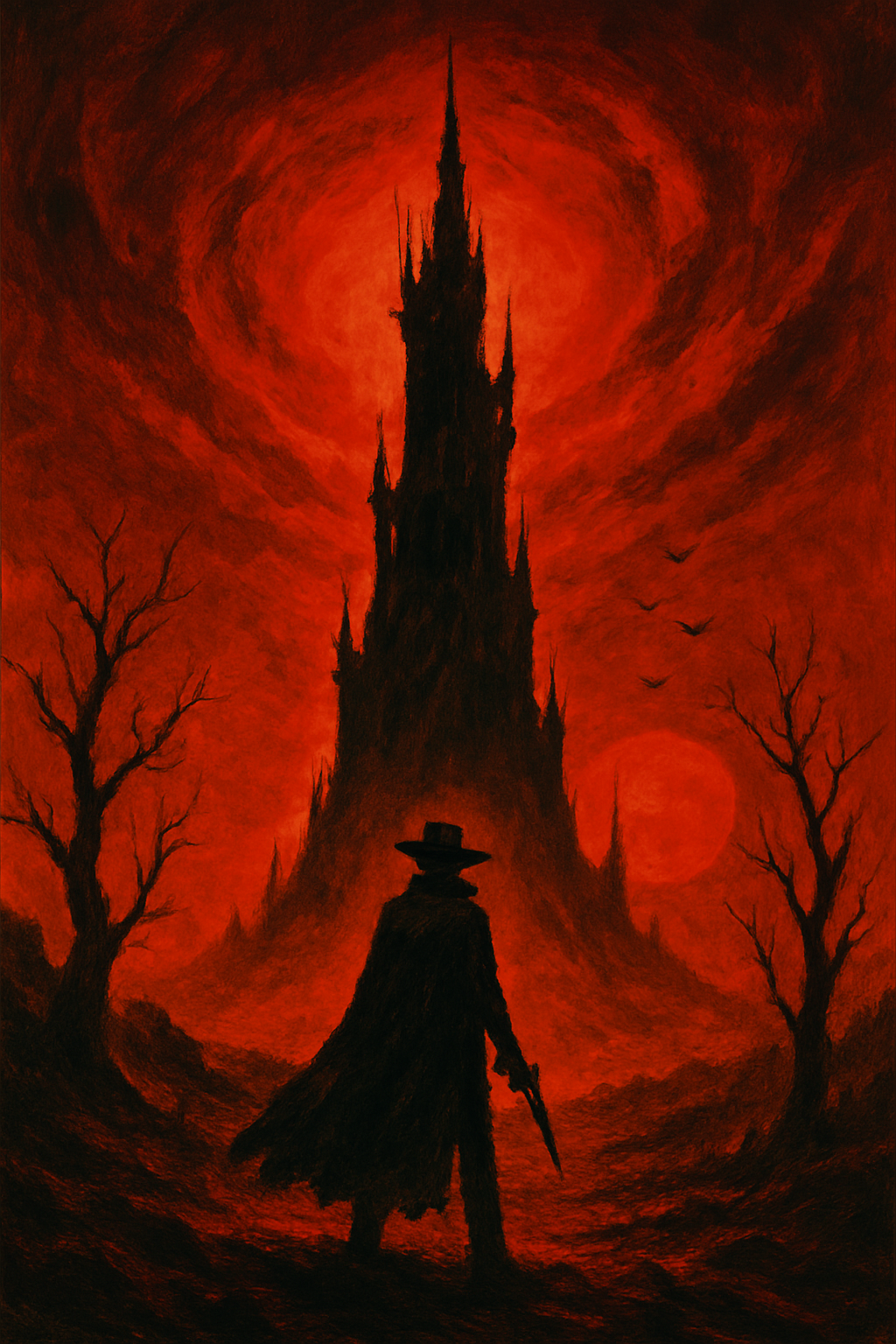
Dark Tower Image courtesy of ChatGPT

From heroic to epic and everything in between, the fantasy genre has something for everyone who loves a touch of magic in their fiction.  Fantasy is defined as any story, artwork, or film with elements that are scientifically impossible and are often set in imaginary worlds. That which is impossible is explained as magic and includes people or things that can do the extraordinary.

Dark fantasy takes those elements and adds horror.

These works, which include literary works, art, and film, are dark and gloomy and often give the viewer a sense of horror and dread.

There is still a bit of debate between the finer points of what elements make up a dark fantasy. The point where people are divided comes down to the setting. Some argue that supernatural horror set on earth should be considered “contemporary fantasy” and “dark fantasy” should be reserved for supernatural horror that occurs on secondary worlds.

The term gets confused further when writers use the term “dark fantasy” and sometimes “gothic fantasy” it as a less lurid way to refer to horror.

Because the definition is fairly vague, works classified as “dark fantasy” come in every shape and size. There are no elements or tropes that must be present beyond the presence of supernatural elements and a dark, brooding, tone. So yes, there be vampires and werewolves here.

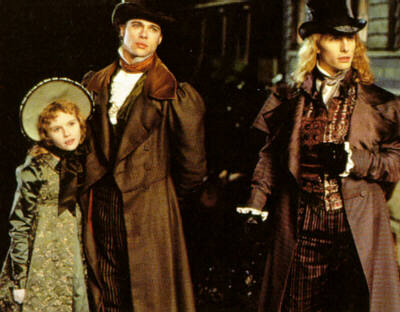
iwtv_family
And everyone knows that these Edwardian vampires wouldn’t dare sparkle.

Popular works that fit in the Dark Fantasy category include: Anne Rice’s Vampire Chronicles, Neil Gaiman’s The Sandman, and Stephen King’s Dark Tower Series.

***

Read more Genre Talk articles:

Keeping the Story Real

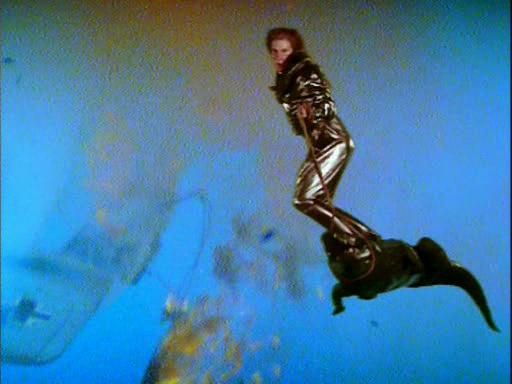
If Ace Rimmer can ride a random alligator then it must be ok, right?

If Ace Rimmer can ride a random alligator then it must be ok, right?

It’s writing Wednesday and yet another chance to inundate the webverse with more unsolicited writing advice. Woo Hoo!

Today’s topic is about keeping it real when it comes to plotting a story. I’m sure we’ve all seen or read at least one story where something happens that’s hopefully exciting or at least vaguely interesting, but has nothing to do with the story. Jack M. Bickham refers to this as “dropping alligators through the transom.”

Unless your story is about mutant alligators taking over an office building, there is probably no good reason for it to happen.

I can hear the argument already.”This scene was kinda dull so I thought adding killer bees would add a bit more interest.”

Ahem… If your scene was dull, and you knew it was dull, why is it even in your story? Just sayin’

The point that I’m trying to make is that all story elements need to make sense. Being super cool isn’t a good enough reason to add something new. It has to feel like it belongs. David Farland also talks about this in different terms.  He says that the story needs to be honest to itself. This doesn’t mean it has to be true, a good piece of fiction weaves together a multitude of realistic elements in new and intriguing ways.

Not sure if you are guilty or not? This is where having another critical set of eyes check over your story can be a life saver. As writers we can get blind to our own work. The story is so alive in our head that it’s hard to see when we might have added something that doesn’t make sense.

So, what happens if we have dropped the proverbial alligator? Relax. It’s not the end of the world. One of two things might have happened. The first is when you have added something that totally works in your world, but you’ve neglected to build your world enough to make it feel natural to the reader. The fix is to add a few more passages during the early chapters of the book, or scenes of the story, that make your alligator fit.

The other thing that might have happened is a bit tougher to fix without removing the offending element entirely. This is when something has been added to spice things up, but it feels like it doesn’t belong with the story.

Say you have a space captain that needs to land his failing craft before it explodes. It’s taken a hit from a Xabulon warship and is being pulled into the planet’s gravity. While wresting the controls, the second-in-command has an allergic reaction that swells his throat shut.

We have two big problems. Saving the second-in-command and landing the ship safely. If the allergic reaction has something to do with the enemy that they are facing then by all means use it and slam your readers with a super dramatic scene. However, if it doesn’t, it feel like it’s coming from nowhere and might just serve to confuse or worse take focus away from the real problem.

There is one place where random elements work well, and that’s with humor. This is where introducing the delightfully unexpected can pay off. That said, there are limits. Too much and it comes across as goofy or silly. Ace Rimmer, seen in the picture above, is a character in the BBC space comedy Red Dwarf. His entire character revolves around the absurd and unlikely, like riding an alligator to escape an exploding airplane. It’s silly and not at all logical and that’s what makes it fun.

Whatever you end up doing, Mind your alligators and Happy Writing!
Writing Fantasy Profanity

Bantha-ST

Don’t mix up your Bantha Poodoo with your Nerf Herders! Getting swearing right is important.

It’s writer Wednesday and today we are going to delve into the risque topic of fantasy profanity. Well, ok, it’s not all that risque. In fact, the reason many people like fantasy novels is that there is rarely ever any swearing.

Instead, we enter the world of alternate swearing. In a fantasy world there are different beliefs and different cultural practices that lead to different terms being considered profane, just like different English speaking countries have distinct swear words. Saying ‘bollocks’ or ‘bloody’ in the US barely gets an eyebrow raise because most people don’t know what they mean.

Using standard swearing in a fantasy novel doesn’t make sense because you wouldn’t expect an alternate civilization to develop the same swear words. When they are used they pull the reader from the narrative – a big NO NO.

Let’s see how these titles handle swearing –

Mazerunner, James Dashner: (I’m talking about the book, not the movie) The Gladers those who live withing the maze use ‘shuck’ and ‘clunk’ ans their stronger swears.

  • Clunk is a direct replacement for sh%t and comes directly from the sound made when using the rustic bathroom – and yes, this is explained in the book.
  • Shuck rhymes with fu%k for a reason.
  • Other slang includes: shank, slim it, slinthead, greenbean, jacked, and bloody.

Wheel of Time, Robert Jordan and Brandon Sanderson: There are a plethora of these, for the complete list, check out the wiki. These words are tied directly to the world where much of the protagonists history includes blood, fire, and magic. The most popular swear words are the following:

  • Flaming used much like we use ‘damn’ and expresses anger or hatred toward something or someone.
  • Blasted a slightly stronger version of ‘flaming’
  • Light used as an exclamation similar to how we use ‘god’
  • Burn (me, you, etc) is also similiar to damn and is used when people are upset
  • Blood and Ashes expresses anger and disgust.

Star Wars Universe: While this is sci/fi the same rules apply – it’s not our world or culture so the swear words would be different. I was actually surprised at how many of these there are, for a complete run down, including origins and definitions, check out this article.

  • F-bomb substitutes: crink/crinking, farkled. kark/karking, kriff/kriffing, krong, Skrog/skrogging, snark/snarking (no relation to today’s snarky).
  • S-word substitutes: druk, dwang, Holy Sith!, shab, shavit.
  • Other Insults: Bantha poodoo, e chu ta, hutt-spawn, laserbrain/blaster brain, lurdo, nerf herder, schutta, sculag, sleemo, son of a blaster, stoopa, vong.

Needless to say, there are many ways to handle swearing in your world.  The more deeply embedded into the culture and world, the better these insults will be.  If your world has a lot of water elements then there should be some water related swearing and insults, wethead, salt and slime, salty, bilge, etc. A desert culture would use a different set that evoked images of heat, dry, and stench.

Whatever you do, make it meaningful. Random words used as swear words won’t affect your reader nearly as much as words that have a history and a purpose.

Happy Writing!

Grammarland: Then vs Than

It’s Writer Wednesday here and today we will tackle a mini grammar concept – the difference between then and than. These writing-themed posts used to be the weekly mainstay of my other blog, My Literary Quest, but will now be hosted here and reblogged there.

Then can be used as three different parts of speech, which is probably why it gets mixed up so often with than. The main use of then is as an adverb, specifically to situate an action in time. For example,  she attended English class and then went to lunch. It’s also part of the if … then construction –If you clean your room, then I will tell you my secret.

Then can also be used as a noun meaning that time. (e.g., “I wanted to scream, but then was not the time.” To me this sounds a bit clunky and dated, but it’s a valid use.

The last use of then is as an adjective, meaning at that time. This usage is the most awkward of all, but I have seen it used at times. Her then apartment was full of ants.

Of note – both of the last two uses of then are passive voice. If you catch yourself using them in fiction you might want to carefully consider if that’s your best option.

Everyone still following along? Great! Moving on to than.

Than is a conjunction used for making a comparison. That is it. That is it’s only use. In fact, than is so unique that you can’t swap it out of a sentence. (e.g., “She’d rather have butter than cream cheese.”)

Pop quiz! Write down your answers and see how you do.

  1. There is nothing better (then/than) choosing to “like” this post.
  2. If you can breathe, (then/than) you can share this blog with a friend.
  3. The (then/than) Prime Minister of the UK would like this blog because it talks about Doctor Who from time to time.
  4. Read the post first, (then/than) leave a brilliant comment.
  5. I personally would rather be eating chocolate (then/than) taking a silly grammar quiz.
  6. If you would like to go sneak some chocolate (then/than) go do it, I won’t judge.

Here are the answers:

1. than 2. then 3. then 4. then 5. than 6. then

Get all six right? Woohoo! You are a grammar ninja! Didn’t? It’s ok, try and try again!

Keep up the good work and as always –

Happy Writing!

Helpful links:

Want to see more Grammarland posts? Check out the whole collection at this link!

The Finish Line is in Sight

Next week marks the magical and wonderous time where I send the oldest two children back to school. This is the first year when they will both go for the full day and I can’t contain my excitement.  The last six weeks of summer vacation have been exhausting, the house is a mess, and the unending chorus of “I’m bored!” has grated me down to my last nerve.

I’m looking forward to spending more uninterrupted one on one time with my youngest. With the other two around it’s been hard to focus on just him because brother and sister come and need me to do something, or want to do what we are doing, or start arguing and force me to divide my attention.

I’m also hoping to find more writing time.  With all three in the house it’s been too chaotic to sit at the computer and focus.  At the beginning of the summer I had finally reached the part of my draft that didn’t need extensive renovation. Not being able to work on it has been sheer torture.

Writing with a two-year-old in the house will still be a challenge, but it’s got to be easier than having all three rattling around.

Heck, I might even finish the Man in the Cupboard series!

A Weighty Issue

Writing is a sedentary activity.  Although there are several clever ways to make it less of one, the fact is most people do it while sitting. There are treadmill desks where writers can walk slowly while they tap away at the keys. There are standing desks where instead of sitting you stand which is supposed to be better for the core and all the supporting muscles, and then there are a variety of balls and other sitting things that are supposed to encourage movement.

I’ve tried the standing desk and found that I avoided working at the computer because of it. It made more parts of me hurt than simply sitting.  My back hurt, my feet hurt, my neck hurt, it wasn’t worth it, even if it was “healthier.”  I must have been doing it wrong.  Perhaps I should have tried it while wearing shoes.

I tried sitting on an exercise ball and liked it but mine was not large enough and a bit under inflated to boot so that when I sat on it my chin was level with the edge of the desk. Even if I had the right one and it was perfect I just know that my kids would steal it every chance they could and use it to bowl for their little brother.

The problem with needing to spend extra hours at a keyboard is that you don’t have those hours to do healthier things.  And if you’re any bit like me you also use that time to nibble.

Because of this I’ve found stray pounds being attracted to me little lost puppies.  The first few didn’t bother me, there were even kinda cute in a way. Well, not really. The problem started when they started inviting friends to come and hang out around my midsection.

Now, it’s time to declare war. I’m tired of finding that half my pants no longer fit and want my old belly back. This means sneaking in more activity and exercise during the day and watching calories.

Bring it on.

Tomorrow.


My Distractions are Bigger Than Yours

For all those who are anxiously waiting for another episode of Mike Finnegan, I apologize. He will be making his next appearance next Friday when I have had time to write another episode.  For now, I only have time and energy for a brief update.

I’ve had my novel on my mind constantly these last few weeks and it’s been driving me crazy that I haven’t had any significant undisturbed time to really dig in and build up my characters.  It’s not that I can’t work with the little ones around, I can.  It’s just that the quality suffers.  I read through a few passages that I’d written while being besieged with requests and even physically pulled away from the keyboard every few minutes and found that although the writing is okay, the characterization really suffers.  When I can’t focus, I can’t get inside my character’s heads and live the scene through their eyes.  And for me, one of the most vital requirements of a great book is that the reader feel fully immersed in the characters.

For first drafts this isn’t as big of problem, but now I’m deep into near final drafts where I’m trying to hone and refine all the different aspects of the story, the inability to find that laser focus and actually work on it is driving me crazy. I’ve played with the idea of starting a small contest called “My Distractions are Bigger than Yours” and feature pictures and videos of all the crazy things that happen when people are trying to work.

This would be the first submission –

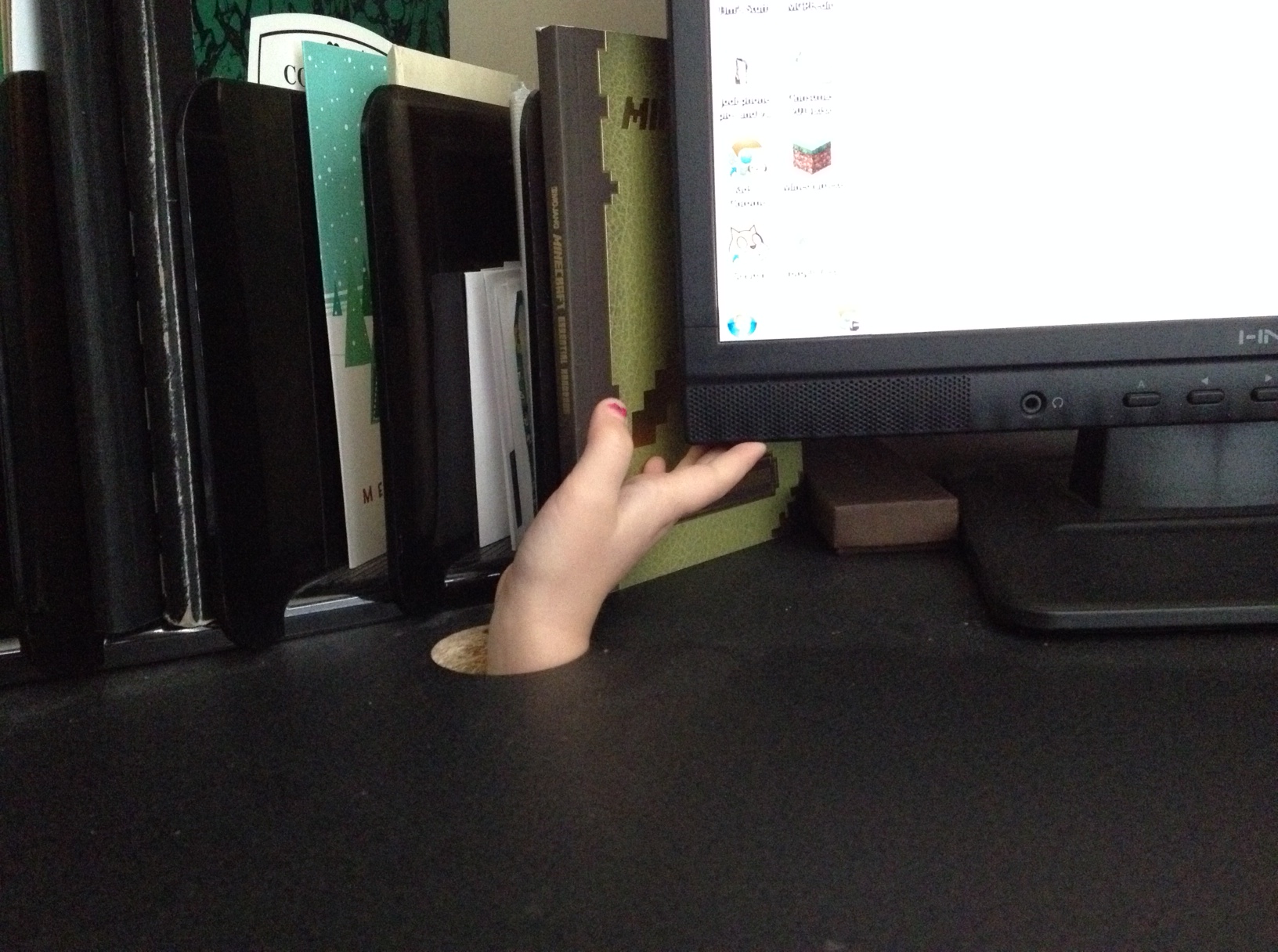
Creepy Baby HandYes, that’s a hand reaching through my desk and touching my screen. At least she can’t reach the monitor power button from there, the hand itself is distracting enough, having the screen turn off and on would be the last straw.  Sometimes I keep goodies like jelly beans that I can offer the hand, sometimes the hand brings me gifts like small toys.

On rare occasions I get dual hands, there is a second hole in my desk on the other side meant for cables and baby D will come and play along.  Sometimes the hands want to play catch with each other and get angry when it doesn’t work.

Where there are little hands there are also little bodies trying to sit on my feet.  The way this is going I’m not going to finish the book until my youngest starts going to school!

What are your worst distractions?